



High temperatures, dust accumulation and waste gas buildup can push employee turnover rate up to 28% and reduce production efficiency by 35%. Against this backdrop, industrial negative pressure fans, with powerful performance of 90,000 cubic meters air exchange per hour and up to 97% cooling efficiency, have become the top ventilation and cooling choice for more than 60% of manufacturing enterprises. However, the market is flooded with brands of uneven quality. Shengu, Shangfeng Hi-Tech, Jintongling and other manufacturers each have their own strengths. How should factories select the right model? Why do 90% of buyers end up working with professional service providers instead of purchasing equipment directly? Ruifeng interprets the purchasing guide for industrial negative pressure fans with real data.
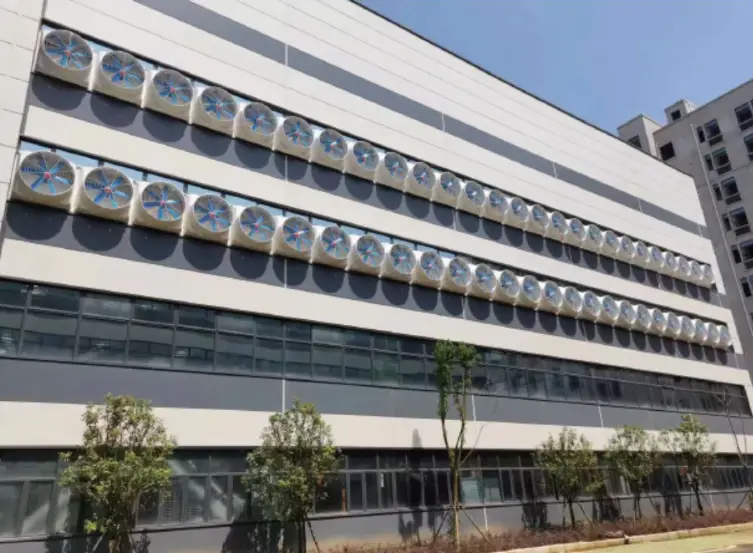
The core working principle of industrial negative pressure fans is air convection and negative pressure ventilation. The impeller rotates to create negative pressure, forcibly extracting hot air, dust and hazardous gas out of the workshop, while fresh air flows in through gaps around doors and windows to form a circulating “exhaust-air intake” system.
Compared with traditional axial flow fans, these units deliver 18,000–60,000 m³/h exhaust volume (capable of fully replacing air inside a 1,000 ㎡ workshop within 5 minutes), with ventilation efficiency of 90%–97% and maximum air change rate of 99%. They reach peak performance within seconds after startup. For example, after installation in a foundry workshop, indoor temperature dropped from 42°C to 30°C and dust concentration fell by 90%.
Data clearly shows the outstanding cost-saving and efficiency-boosting advantages of negative pressure fans. Each unit only consumes 0.75–2.2 kW, costing roughly 1 CNY per hour — only one-eighth of the power consumption of air conditioners. Its installation cost equals one-fifth of central air conditioning (around 50,000 CNY for a 1,000 ㎡ workshop), and complicated piping is not required. More importantly, it fits a wide range of application scenarios: it removes intense heat in high-temperature workshops such as casting and forging lines; extracts lint and debris in dusty workshops for woodworking and textile production; dilutes formaldehyde and ammonia gas with 95% dilution efficiency in chemical workshops; and stabilizes temperature and humidity in logistics warehouses, cutting goods mildew risk by 60%.
Brand Selection Guide: Well-reputed Brands With Differentiated Advantages
Shengu / SBW specializes in high-pressure fan technology. Its products suit high-altitude and high-humidity environments and hold a 35% market share in the metallurgy industry.
Shangfeng Hi-Tech focuses on low-noise design with running sound ≤65 dB, equivalent to normal conversation volume. It ranks first nationwide in installed units for textile mills.
Jintongling / JTL is famous for high-airflow models delivering 60,000 m³/h per unit, the preferred option for large warehouse spaces.
Many enterprises run into troubles during procurement. One auto parts factory once bought fans from a famous brand directly, but ignored airflow routes during installation. As a result, local dead zones still stayed as hot as 38°C, forcing costly secondary renovation. This demonstrates the value of professional service providers: they do not merely supply hardware, but maximize equipment performance through customized solutions.
Take Wenzhou Ruifeng Environmental Protection Refrigeration Equipment Co., Ltd. as an example. As an authorized service partner for multiple negative pressure fan brands, its core competitiveness lies in meticulous execution. During pre-installation surveys, engineers use anemometers, temperature and humidity meters to accurately measure workshop dimensions, heat source distribution and window & door positions. Layout plans are formulated referring to the Whitepaper on Industrial Ventilation Technology. For instance, a 1,000 ㎡ workshop usually requires five 1.5 kW fans arranged symmetrically. During installation, air outlet angles and unit inclination are strictly controlled to guarantee straight airflow without dead zones. Heat insulation materials are wrapped around pipelines to reduce air resistance. Regular maintenance services include belt tension adjustment, guard cleaning and bearing lubricant refilling, extending equipment service life from 5 years to 8 years.
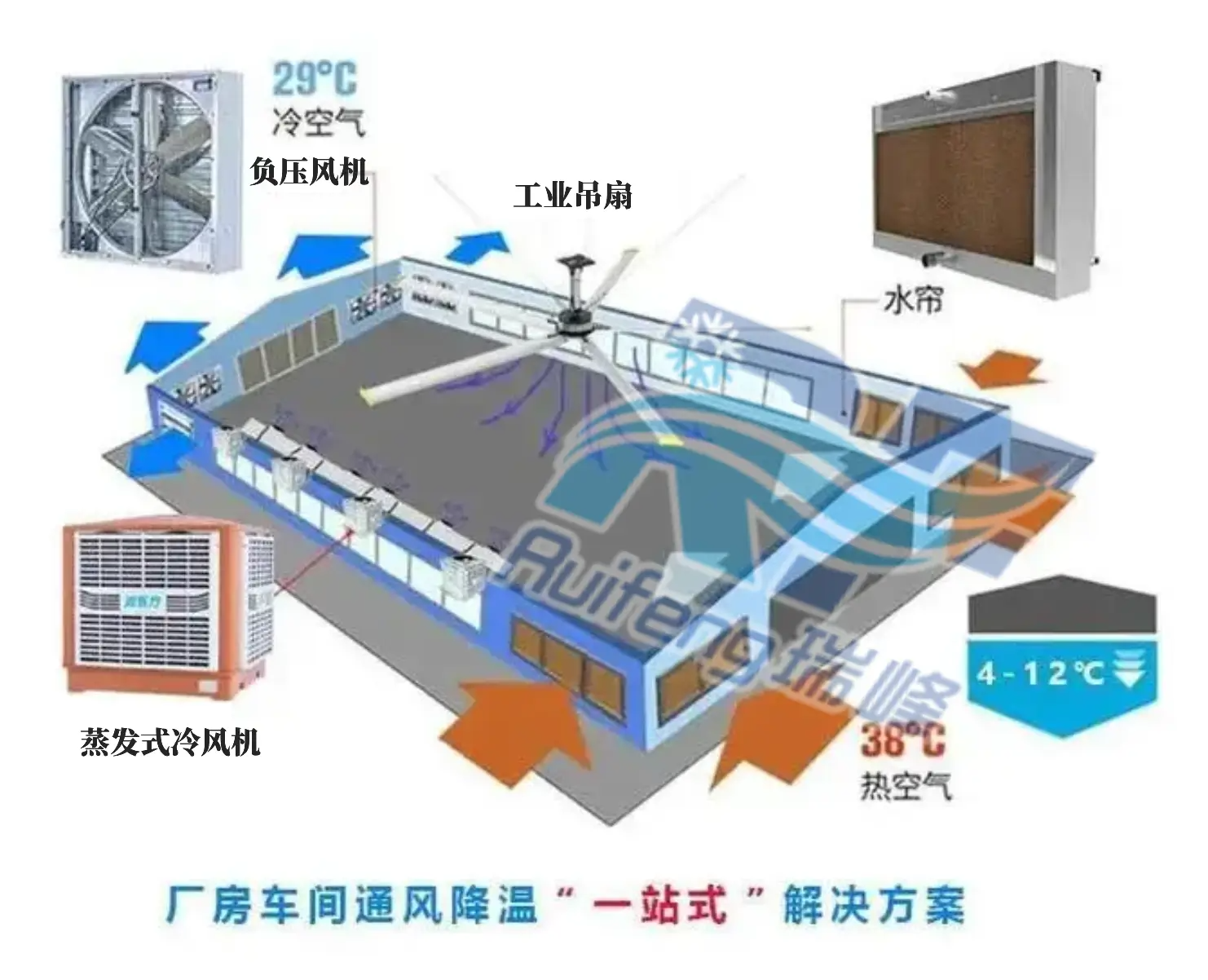
Additionally, Ruifeng Environmental Protection’s one-stop service covers combined multi-equipment schemes. When paired with water curtains, negative pressure fans can further lower intake air temperature by 5–8°C. One food factory kept its summer workshop temperature stable below 28°C with this setup. Combined with HVLS industrial ceiling fans, overall air circulation efficiency rises by 30%. In a logistics warehouse case, goods mildew rate dropped from 12% to 2%. So far, its service network covers 8 cities including Wenzhou, Taizhou and Ningbo. The team has delivered solutions for over 3,000 enterprises, achieving an 85% customer repurchase rate and ranking top three in the 2025 Zhejiang Industrial Service Provider Satisfaction Survey.
For manufacturers, buying industrial negative pressure fans means investing in higher productivity, regulatory compliance and staff health, rather than just purchasing hardware. Beyond brand rankings, the expertise of your service partner determines the final outcome. A professional team can lift equipment performance by an extra 20%–30%, which is critical for enterprises to cut costs and raise profits amid fierce competition.
If you are sourcing reliable industrial cooling equipment service providers, picking the right supplier matters greatly. Wenzhou Ruifeng Environmental Protection develops customized professional environmental optimization solutions for you. Our one-stop service simplifies everything from product selection and installation to operation. Feel free to contact us for inquiries!